INKplant
Project description
INKplant – ink-based hybrid multi-material fabrication of next generation implants – is an EU H2020 project that is significantly shaping the future of regenerative medicine. Its starting point is one of Europe’s greatest challenges: the aging population. By 2024, around 22% of Europeans will be over 65 years old. Many suffer from chronic joint damage, osteochondral defects, or defects in the oral and maxillofacial region, which severely limits their quality of life and places a constant burden on health and social systems. The COVID-19 pandemic has further demonstrated the consequences that a large number of chronically ill and care-dependent patients have on hospitals and infrastructure.
This is where INKplant comes in: Under the coordination of PROFACTOR, a total of 19 partners – including universities, research institutions, SMEs, global industrial companies, and university hospitals – have been working since January 2021 on new solutions for biomimetic, patient-specific implants. The core idea is the combination of various biomaterials, 3D printing technologies (additive manufacturing), and novel evaluation methods to develop implants that mimic the biological and mechanical behavior of bone and soft tissue as realistically as possible. INKplant thus combines 3D biofabrication, regenerative medicine, and personalized implantology in a pioneering European flagship project.
Project objectives and technical innovation
The €6 million INKplant project aims to establish a hybrid, ink-based, multi-material additive manufacturing process for the next generation of medical implants. The focus is on:
- Patient-specific implants through the combination of different biomaterials and high-resolution 3D printing technologies
- Biomimetic implants that functionally replicate hard and soft tissue and integrate better into the body
- Standardized workflows from imaging and design to production and preclinical evaluation
Technically, INKplant relies on a hybrid platform of lithography-based ceramic fabrication (LCM) and 3D multi-material inkjet printing. This enables the creation of highly precise, complex structures with finely tuned material gradients – for example, hard, load-bearing areas for mechanical stability combined with more elastic, bioactive zones for tissue regeneration. New simulation and evaluation methods, as well as aspects of standardization and bioethics, are integral components to pave the way from research to clinical application. The consortium includes leading experts in tissue engineering, biomaterials, 3D printing, standardization and regulatory affairs, as well as world market leaders such as Lithoz and Stratasys and four university hospitals, including Charité Berlin and AKH Vienna.
Benefits, Application & Long-Term Effects: Personalized Regenerative Therapies for Joint and Jaw Defects
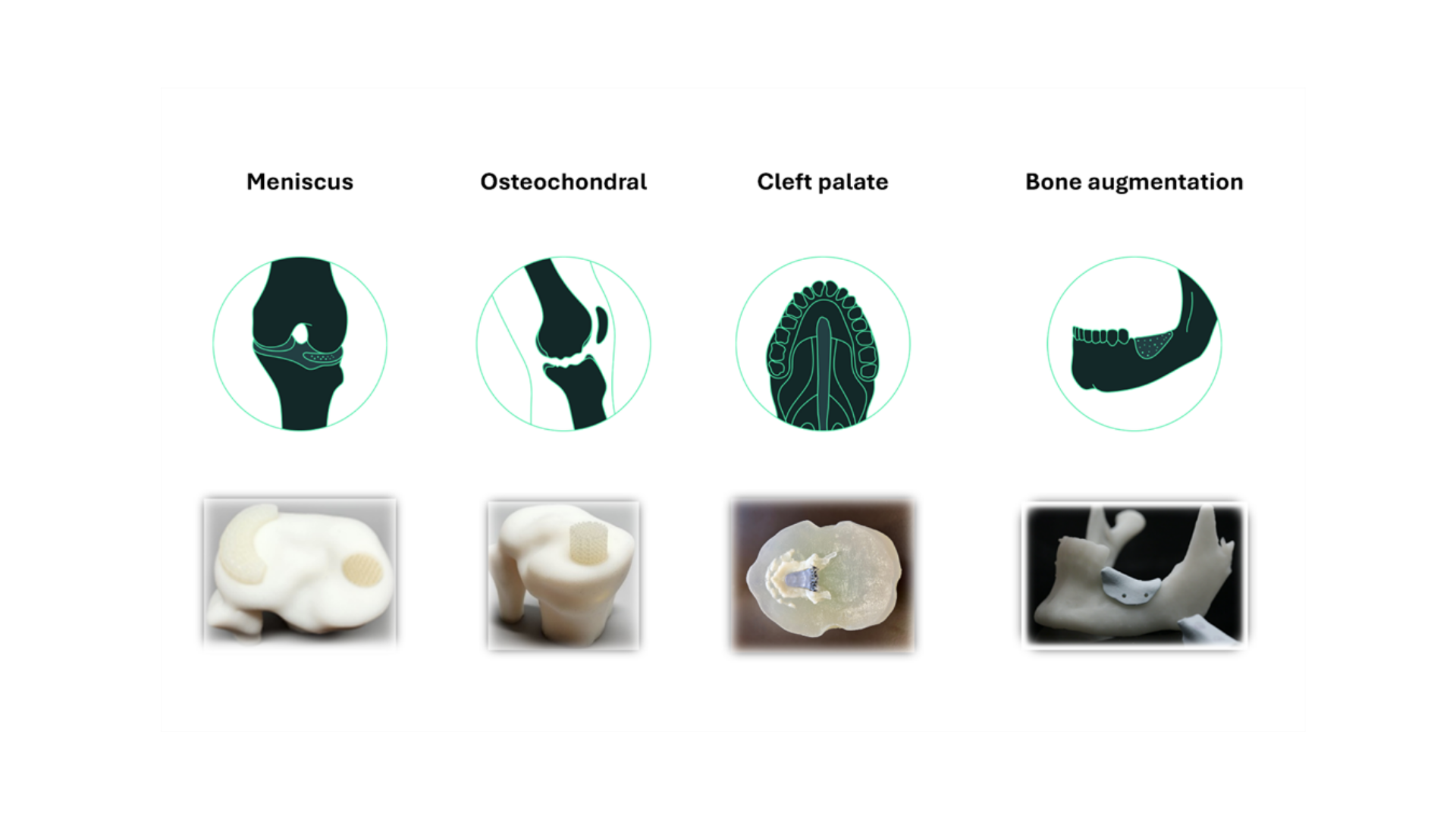
- Specific Use Cases: INKplant develops implant solutions for four key indications:
- Meniscal implants and implants for repairing osteochondral defects in the knee, to avoid total joint replacement whenever possible.
- Palatal defects and complex defects in the oral and maxillofacial region, such as those resulting from tumors or congenital malformations, including patient-specific implants for dental and oral rehabilitation.
- For Patients: More biocompatible, better integrated, and individually tailored implants promise fewer complications, fewer revision surgeries, shorter rehabilitation times, and a significantly improved quality of life – especially in old age.
- For Healthcare & Society: Through lower complication rates, shorter hospital stays, and a reduced need for follow-up surgeries, INKplant aims to lower healthcare costs and utilize resources within the system more efficiently. The combination of personalized medicine and highly automated 3D printing processes creates the foundation for individualized, gender- and anatomy-specific therapies on a near-industrial scale.
- For Research & Industry: INKplant strengthens Europe’s position in 3D biofabrication, promotes standardization and ethical guidelines for 3D-printed implants, and generates new expertise for SMEs, hospitals, and research institutions. The project demonstrates how medicine and technology can collaborate in an integrated approach to bring regenerative and personalized therapies from the laboratory to everyday clinical practice.
INKplant will thus make a sustainable contribution to improving the quality of life for older people and further strengthen the EU’s role as a hub of scientific excellence in the field of regenerative, personalized medicine and 3D printing of medical implants.