PrintedRadar
Project description
To date, so-called patch antennas, flat antennas made of conductive materials, have been used in the radar industry. These must be manufactured on low-loss dielectric and extremely expensive substrates (e.g., Rogers substrates) and, due to their flat geometry, must be large to minimize negative interference between individual radar channels. New developments aim to use waveguide systems in combination with 3D antennas, such as horn antennas. Such designs offer the possibility of miniaturization while simultaneously improving the performance of the entire radar system.
Project objectives and technical innovation
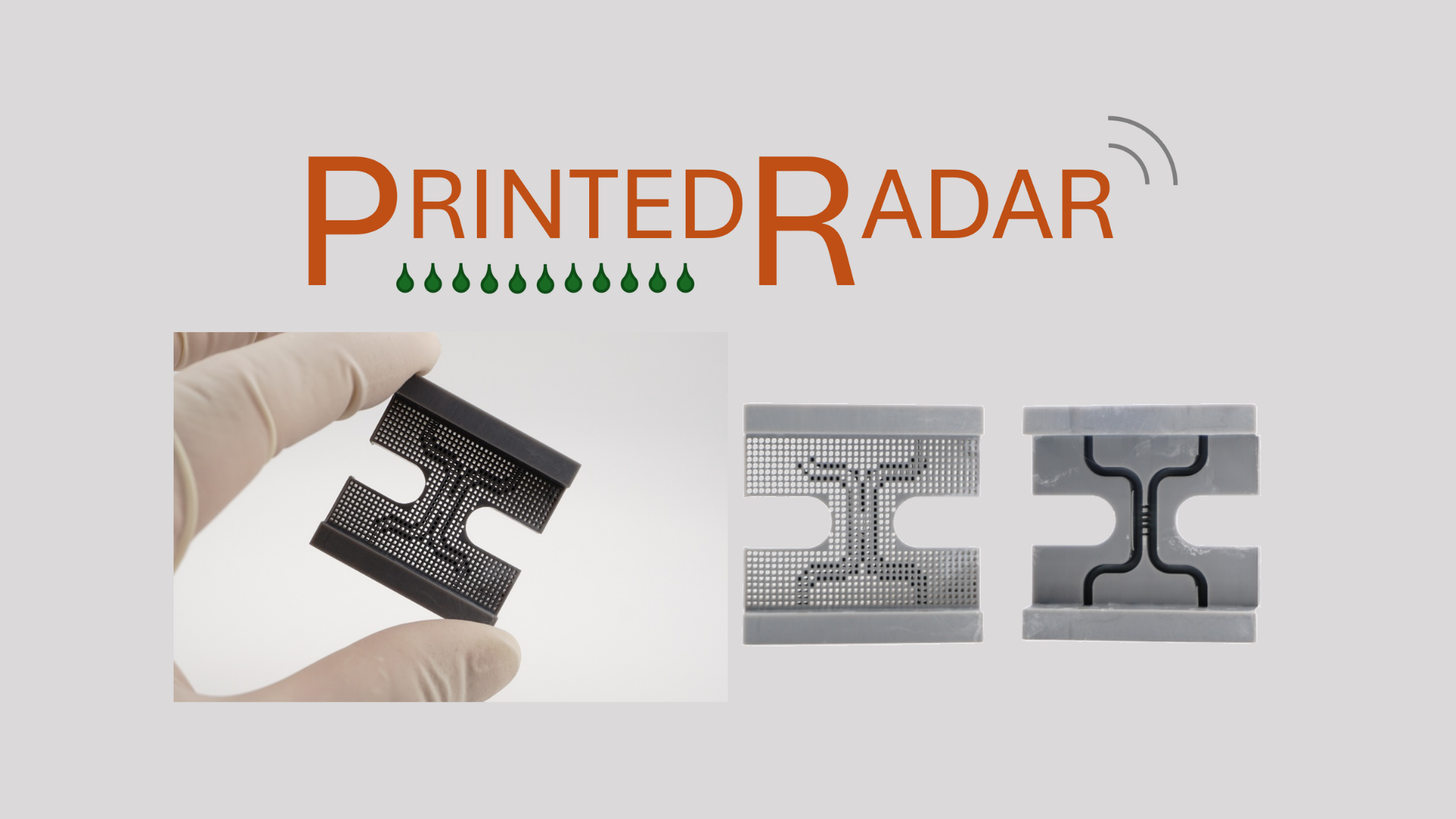
The PrintedRadar project is developing innovative 3D waveguide radar antenna systems for autonomous mobility using additive manufacturing technologies. The goal is to replace flat patch antennas with high-performance waveguide structures that enable miniaturization and improved performance.
Technically, the project combines processes such as SLA, DLP, and multi-material inkjet printing with subsequent metallization to directly additively manufacture complex polymer waveguides. Particular emphasis is placed on reliable metal coating and the highest surface quality. Through extensive simulations, prototyping, and material characterization, a scalable manufacturing process is being developed that allows for rapid iterations, design flexibility, and high quality even in small production runs – a sustainable boost to innovation in radar sensors for mobility.
Additive manufacturing of 3D waveguide antennas for compact high-performance radar systems
- Printed 3D waveguide antennas enable compact, high-performance radar systems for vehicles, drones, and industrial applications—a crucial step toward safe, connected mobility.
- Additive manufacturing combined with metallization reduces material consumption, allows for rapid design adjustments, and makes small production runs economically viable.
- Developing new processes for precise waveguide structures and reliable metal coatings opens up new avenues for high-frequency components and radar sensors.
- Efficient material utilization and digital manufacturing technologies promote resource-efficient production and create the foundation for industrial scaling.