Sustainable Robotics and Automation: PROFACTOR at ADRF26 2026
Automation for Flexible ManufacturingEventIndustry 5.0Sustainability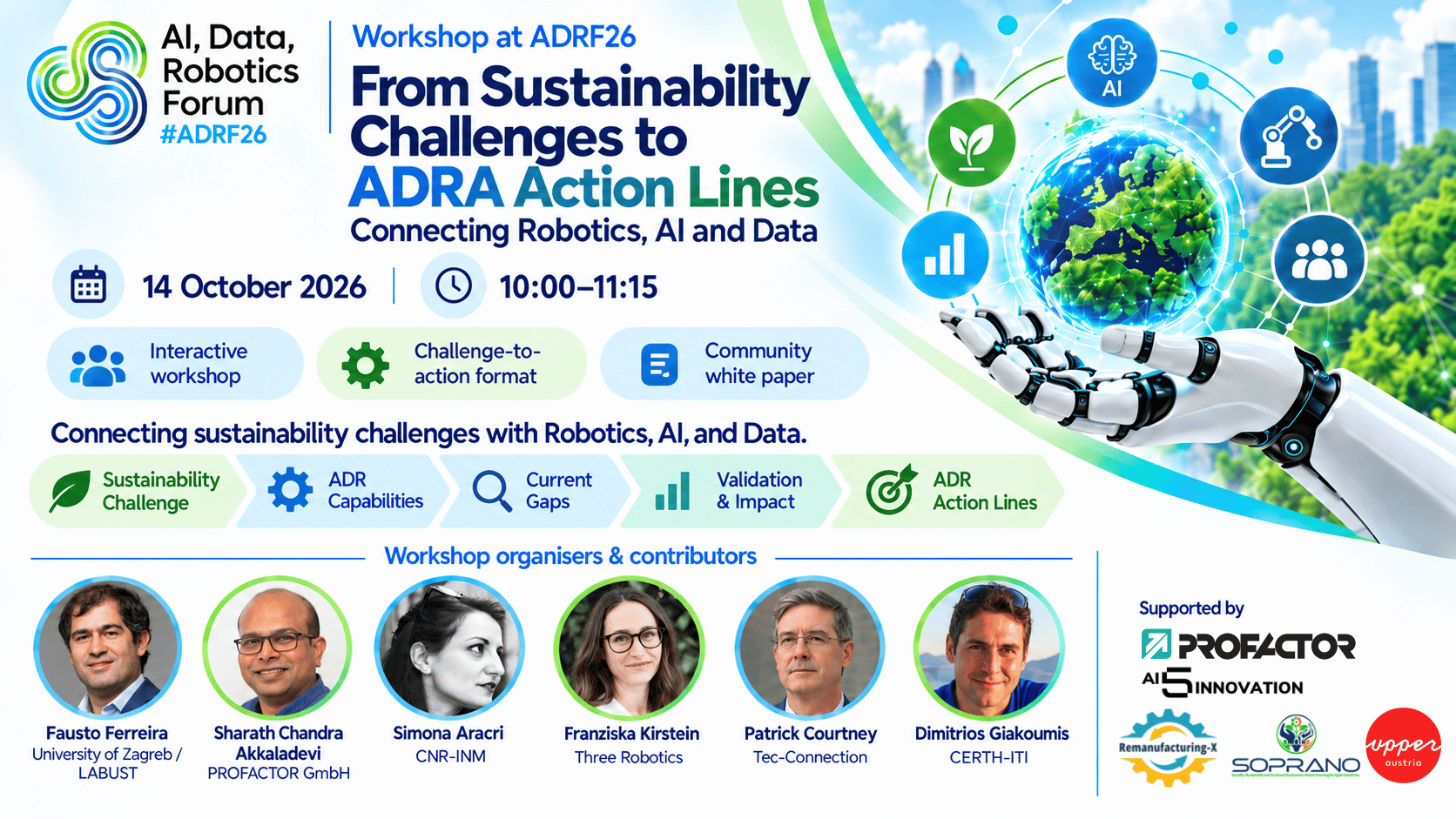
PROFACTOR is bringing its expertise in robotics, automation and human-robot collaboration to the AI, Data and Robotics Forum 2026 in Porto. Sharath Chandra Akkaladevi, Scientist in Robotics and Automation Systems at PROFACTOR, is one of the organisers of the workshop “From Sustainability Challenges to ADRA Action Lines: Connecting Robotics, AI and Data.”
The workshop will take place on 14 October 2026 from 10:00 to 11:15 and will explore how robotics, artificial intelligence and data can jointly contribute to greater sustainability in industry, infrastructure, environmental monitoring and other application areas.
Robotics, AI and Data for Sustainable Applications
Sustainable robotics is about more than reducing the energy consumption of robots. Modern automation systems can help make industrial processes more resource-efficient, support repair, reuse and recycling, and enable new solutions for environmental monitoring, inspection and renewable energy.
At the same time, robotic systems are expected to become increasingly flexible and intelligent. They need to cope with product variants, changing environmental conditions and complex tasks.
This is exactly where the ADRF26 workshop comes in. It will focus on the capabilities required from robotics, AI and data processing, the technological and organisational gaps that still exist, and the concrete research and innovation measures that can be derived from them.
From Sustainability Challenges to Concrete ADR Action Lines
The discussion will follow a clear challenge-to-action approach:
Sustainability Challenge → ADR Capabilities → Current Gaps → Validation & Impact → ADR Action Lines
The aim is to translate concrete sustainability challenges into actionable research, innovation and deployment priorities for the European AI, Data and Robotics community.
Participants will discuss, among other topics:
- how robotics can contribute to more sustainable applications,
- which AI capabilities are needed for adaptive and autonomous systems,
- which data and digital infrastructures are still missing,
- which barriers currently limit industrial deployment and scaling,
- how technical performance and actual sustainability impact can be assessed,
- and which concrete measures should be reflected in future European research and innovation activities.
PROFACTOR Contributes Expertise in Robotics and Automation
For PROFACTOR, these topics are closely connected to its own research and development activities.
The company develops solutions in industrial robotics, flexible automation, human-robot collaboration, and intelligent and intuitive robotic systems. A particular focus is on combining modern perception, AI, planning and robust automation in ways that allow robotic solutions to operate reliably under real industrial conditions.
Sharath Chandra Akkaladevi brings this perspective to ADRF26 as one of the workshop organisers. His research at PROFACTOR focuses on robotics and automation, human-robot collaboration, activity recognition and intuitive robot interfaces.
In this way, PROFACTOR positions itself as a research partner for companies looking to transfer AI and robotics into robust, flexible and industrially applicable automation solutions.
International Perspectives on Sustainable Robotics
The workshop brings together experts from different application and technology domains.
Simona Aracri from CNR-INM in Italy will address sustainability challenges from the perspective of marine robotics, environmental observation and autonomous marine systems.
Another contribution will look at challenges and opportunities in the field of renewable and offshore energy.
Dr Dimitrios Giakoumis from CERTH-ITI in Greece will focus on sustainable data creation for robotics and AI. In his talk, “Green Data Creation for Sustainable Robotics: Insights from PLIADES,” he will address topics including efficient data acquisition, edge processing, data curation, reuse and interoperable Data Spaces.
Interactive Group Work Instead of a Conventional Presentation Format
A central part of the workshop will be a roughly 30-minute interactive group session.
Participants will work together on selected sustainability challenges and develop concrete proposals for future ADR Action Lines.
The discussion will not only address technological capabilities, but also data availability, interoperability, validation, scalability and industrial deployment.
Community White Paper as a Concrete Outcome
The workshop results are intended to contribute to a planned community white paper.
The provisional title is:
“From Sustainability Challenges to ADR Action Lines: A European Research, Innovation and Deployment Agenda for Sustainable AI, Data and Robotics.”
The white paper will connect key sustainability challenges with the complementary capabilities of robotics, AI and data. It is also expected to capture research and deployment gaps, suitable validation approaches and concrete recommendations for the European AI, Data and Robotics community.
The results may therefore also contribute to future discussions and roadmap activities within ADRA and euRobotics.
Workshop at a Glance
From Sustainability Challenges to ADRA Action Lines: Connecting Robotics, AI and Data
14 October 2026
10:00–11:15
AI, Data and Robotics Forum 2026 (ADRF26), Porto
PROFACTOR co-organiser:
Sharath Chandra Akkaladevi
Scientist, Robotics and Automation Systems
Through this workshop, PROFACTOR is contributing its expertise in robotics, automation, human-robot collaboration and artificial intelligence to a European discussion focused on linking technological innovation with measurable sustainability impact.
Ort:
Alfândega do Porto Congress CentreRua Nova da Alfândega, Edifício da Alfândega, 4050-430 Porto, Portugal
Standort auf Karte ansehen
Datum & Uhrzeit:
Kontakt:
sakkal@profactor.at