OptiFlow 3D
Project description
Heart failure is one of the leading causes of death in Western industrialized nations and poses enormous challenges for cardiology and cardiac surgery. The number of affected patients is steadily increasing, while suitable donor hearts are extremely scarce. Mechanical circulatory support systems (MCS), such as left ventricular assist devices (LVADs), have therefore become established as a life-prolonging therapy and improve the quality of life for many heart patients. These rotodynamic blood pumps relieve the weakened left ventricle by pumping blood from the ventricle into the aorta in a controlled manner, thus significantly reducing the heart’s workload.
Despite these successes, current LVAD systems are associated with considerable risks. Hemocompatibility problems frequently lead to bleeding, thrombosis, and strokes, significantly worsening the long-term prognosis. Current registry data show that only about 20% of patients remain free of serious complications in the first year after implantation. The situation is particularly critical for children and patients with small stature: For this growing group, there is currently no clinically approved, long-term LVAD technology. This is precisely where OPTIFLOW 3D comes in, developing a new generation of miniaturized, hemocompatible blood pumps for safe, long-term circulatory support.
Project Goals and Technological Innovation
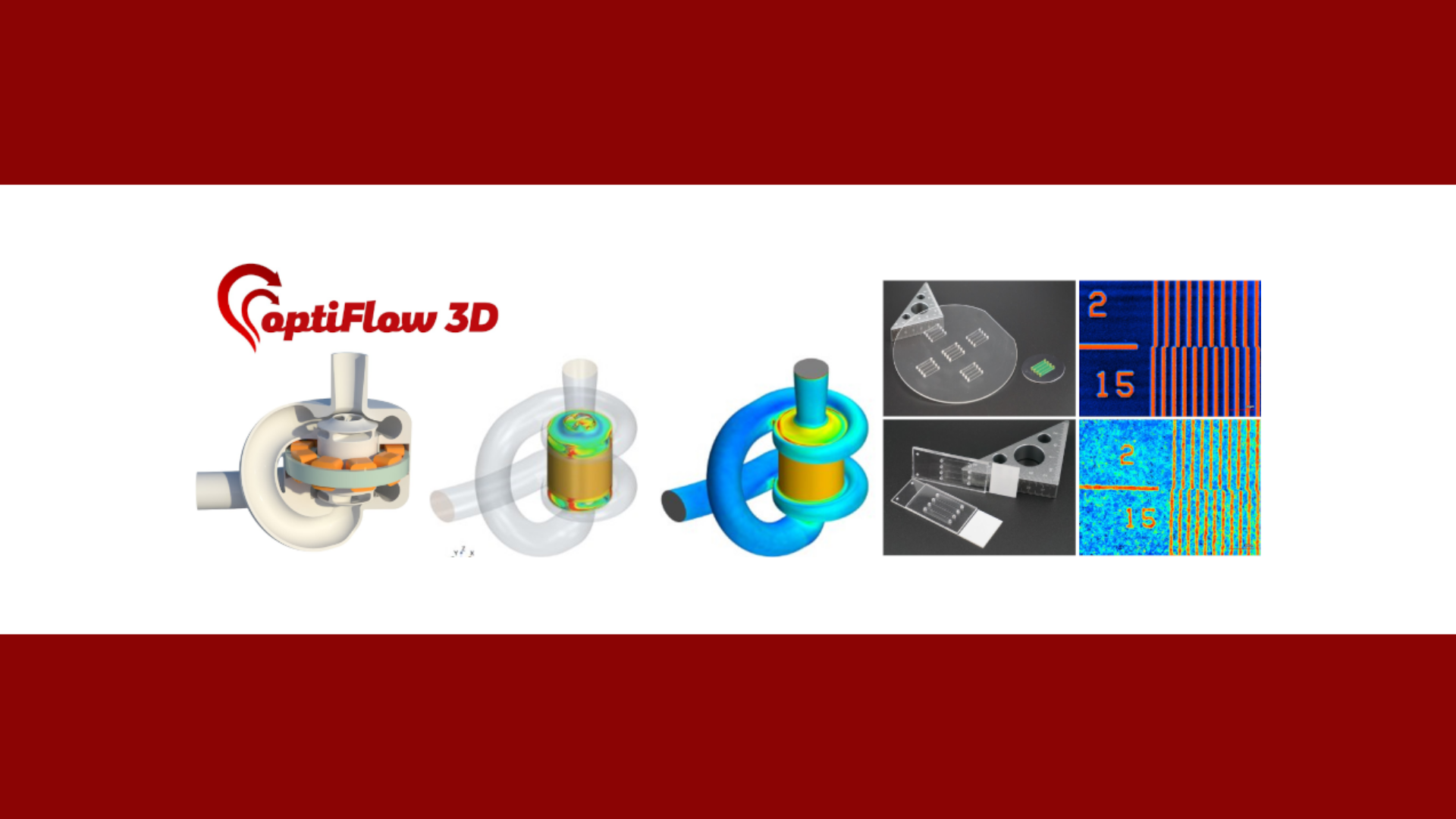
OPTIFLOW 3D closes this gap in care by developing a novel, two-stage, and miniaturized rotodynamic blood pump specifically designed for the anatomy of children and patients with small stature. The goal is highly efficient circulatory support that improves survival rates and quality of life while significantly reducing the risk of life-threatening complications.
The technical basis consists of high-performance ceramics with excellent biocompatibility and wear resistance, combined with state-of-the-art 3D printing (additive manufacturing). Precise shape and surface control enables complex flow geometries and the compensation of shrinkage during sintering. Targeted microstructuring of the pump surfaces using 3D-NIL and two-photon polymerization printing (2PP) optimizes flow conditions, improves hydrodynamics, and minimizes blood trauma and thrombogenicity.
Improved circulatory support: Benefits for heart patients and the healthcare system
OPTIFLOW 3D enables a miniaturized, hemocompatible blood pump that provides long-term circulatory support even for small children and people with delicate anatomies. For physicians and hospitals, lower complication rates mean fewer revision surgeries, shorter hospital stays, and better outcomes. The combination of ceramic 3D printing, microstructuring, and algorithmic process control sets new production standards for cardiovascular implants. OPTIFLOW 3D thus strengthens European medical technology and creates export opportunities in the growing market for MCS systems.
Publications
Press articles
- Forschende arbeiten an winzigen Blutpumpen für schwache Kinderherzen – derStandard, 6. November 2024
Scientific journals
- Michael J. Haslinger, Sonja Kopp, Viktorija Jonaityte, Amiya Moharana, Helene Außerhuber, and Michael M. Mühlberger „Direct patterning of functional materials using nanoimprint lithography„, Proc. SPIE 12802, 38th European Mask and Lithography Conference (EMLC 2023), 128020O (5 October 2023); https://doi.org/10.1117/12.2674052
- Baraghini, N., Eugui, P., Ginner, L., Brosch, N. (2023). Improving 3D Inline Computational Imaging of Textureless Objects Using Pattern Illumination. In: Christensen, H.I., Corke, P., Detry, R., Weibel, JB., Vincze, M. (eds) Computer Vision Systems. ICVS 2023. Lecture Notes in Computer Science, vol 14253. Springer, Cham. https://doi.org/10.1007/978-3-031-44137-0_34
Conference papers
- BDW 2024
- Micropatterned surfaces aimed to reduce the risk of thrombus formation in cardiovascular devices, Bonora M., Viola V., Perak S., Kopp S., Lunzer M., Mühlberger M., Messner B., Moscato F.
- IDBN 2024
- Manufacturing process of microstructured surfaces to enhance hemocompatibility tested in a microfluidic circuit, Marta Bonora, Stjepan Perak, Sonja Kopp, Sarah Linnemeier, Richard Benauer, Markus Lunzer, Marcus Granegger, Michael M. Mühlberger, Francesco Moscato
- NNT2024
- The Influence of Surface Microstructures on the Interaction with Blood for the Use in a Left Ventricular Assist Device, Marta Bonora, Stjepan Perak, Sonja Kopp, Sarah Linnemeier, Richard Benauer, Markus Lunzer, Marcus Granegger, Francesco Moscato, Michael M. Mühlberger
- UV-Nanoimprinting to Modify 3D-Printed Ceramic Surfaces for Life Science Applications, S. Kopp, A. Lale, V. Jonaityte , M. Bonora , M. J. Haslinger , M. Schwentenwein, M. Vostatek, F. Moscato , M. M. Mühlberger
- Nanoimprinting of functional materials for life science applications, S. Kopp, V. Jonaityte, M. Kainz, S. Kauscheder, M. Haslinger, A. Deyette, A. Lale, S. Perak, E. Guillén, M. Mühlberger
- all can be found in the abstract booklet
- MNE2024
- Nanoimprinting of Microstructures for a Left Ventricular Assist Device, Sonja Kopp, Marta Bonora, Stjepan Perak, Sarah Linnemeier, Richard Benauer, Abhijeet Lale, Viktorija Jonaityte, Michel J. Haslinger , Martin Schwentenwein, Matthias Vostatek, Markus Lunzer, Marcus Granegger, Francesco Moscato, Michael M. Mühlberger
- Nanoimprinting using functional materials for the life science, S. Kopp, V. Jonaityte, M. Kainz, S. Kauscheder, M. Haslinger, A. Deyette, A. Lale, S. Perak, E. Guillén, M. Mühlberger
- µTAS 2024
- Combining 2-Photon Polymerisation and Nanoimprint Lithography for Thrombogenicity Assessment in Left Ventricular Assist Devices, Stjepan Perak, Marta Bonora, Sonja Kopp, Michael Mühlberger, Francesco Moscato, Markus Lunzer (link to program)
- Biofabrication 2024
- Thrombogenicity prevention vie micropatterning: design and fabrication of a microfluidic test assay for blood-suraface interaction combining 2-photon polymersization and nanoimprnit lithography, Stjepan Perak, Marta Bonora, Sonja Kopp, Michael Mühlberger, Francesco Moscato, Markus Lunzer
- ISACB 2024
- Thrombus risk in cardiovascular devices: micropatterned surfaces influence platelet adhesion, Bonora M., Viola V., Kopp S., Perak S., Mühlberger M., Lunzer M., Messner B., Fischer B. M., Moscato F.
- ISMCS 2024
- Comparison of a miniaturized implantable two-stage ventricular assist device to equivalent single-stage concepts, Sarah Linnemeier, Bente Thamsen, Stefan Maric, Bernhard Semlitsch, Daniel Zimpfer, Marcus Granegger – Young Investigator’s Award for Sarah Linnemeier
- MUW CVC
- Investigation of Micropatterned Surfaces as Tool to Reduce Thrombus Formation Risk compared to Polished Surface for cardiovascular devices, Marta Bonora, Veronica Viola, Stjepan Perak, Markus Lunzer, Sonja Kopp, Michael Mühlberger, Barbara Messner, Michael Bernard Fischer, Francesco Moscato
- HemPhys3
- Thrombus risk in cardiovascular devices: micropatterned surfaces influence platelet adhesion, Bonora M., Viola V., Kopp S., Perak S., Mühlberger M., Lunzer M., Messner B., Fischer B. M., Moscato F.
- ESAO 2024
- Dynamic analysis of the hydrodynamic bearing of a two-stage pediatric left ventricular assist device, Sarah Linnemeier, Rosario Giuffrida, Spasoje Miric, Daniel Zimpfer, Johann W. Kolar, Marcus Granegger
- Surface modification of cardiovascular devices to reduce the risk of thrombus formation, Marta Bonora, Veronica Viola, Stjepan Perak, Markus Lunzer, Sonja Kopp, Michael Mühlberger, Barbara Messner, Francesco Moscato
- ESB-ViCEM 2023
- Hydrophobic micropatterned surfaces, 2-photon-polzmerization printer, improved hemocompatibility properties, Bonora, M., Riebartsch, B., Lunzer, M., Perak, S., Mühlberger, M., Kopp, S., Viola, V., Moscato, F.
- mrt meet the expert (online)
- The beauty and versatility of nanomprinting, M. Mühlberger
- 49th ESAO-IFAO Congress
- Comparing Wettability Properties of Microscale Surface Pattern Modifications obtained via 2-photon-polymerization, M. Bonora, C. Grasl, M. Lunzer, S. Perak, C. Ghiagheddu, F. Moscato
- MNE2023
- UV-Nanoimprinting of Ceramics, S. Kopp, A. Lale, V. Jonaityte, M. J. Haslinger, M. Schwentenwein, F. Moscato, M. M. Mühlberger
- Fabrication of Surface Microstructures and Investigation of their Influence on the Interaction with Blood for Application in a Left Ventricular Assist Device, M. Bonora, S. Perak, S Kopp, S. Linnemeier, R. Benauer, M. Lunzer, F. Moscato, M. Granegger, M. Mühlberger
- ICVS 2023
- Improving 3D Inline Computational Imaging of Textureless Objects using Pattern Illumination, Nicholas Baraghini, Pablo Eugui, Laurin Ginner, and Nicole Brosch
- NNT2023
- UV-Nanoimprinting to Modify 3D-Printed Ceramic Surfaces, Sonja Kopp, Abhijeet Lale, Viktorija Jonaityte, Michael J. Haslinger, Martin Schwentenwein, Francesco Moscato, Michael M. Muehlberger
- Fabrication of Surface Microstructures and Investigation of their Influence on the Interaction with Blood for Use in a Left Ventricular Assist Device, Marta Bonora, Stjepan Perak, Sonja Kopp, Sarah Linnemeier, Richard Benauer, Markus Lunzer, Francesco Moscato, Marcus Granegger, Michael M. Muehlberger
- Nanoimprinting of Micro- and Nanostructures for Life Science Applications, Michael J. Haslinger, Sonja Kopp, Michael M. Mühlberger
- LBG Meeting Innovation in Health Sciences 2023
- Improving Surfaces Hemocompatibility by Increasing Wettability Properties through Surface Micro-Structuring Modification obtained via 2-photon-polymerization Bonora, M., Grasl, C., Lunzer, M., Perak, S., S. Kopp, M. Mühlberger, Giagheddu, C., Moscato, F.
- ÖGBMT 2023
- Modifying Wettability Properties by Utilizing 2-Photon Polymeriza-tion for Manufacturing Microstructured Surfaces, Bonora, M., Grasl, C., Lunzer, M., Perak, S., S. Kopp, M. Mühlberger, Giagheddu, C., Moscato, F.
- 49th Annual ESAO Congress
- Numerical evaluation of a novel two-stage ventricular assist device for pediatric patients, S. Linnemeier, K. Narayanaswamy, B. Thamsen, B. Semlitsch, S. Miric, R. Benauer, P. Leitl, G. Laufer, D. Zimpfer, M. Granegger
- EMLC 2023
- Direct patterning of functional materials using nanoimprint lithography, Michael J. Haslinger, Sonja Kopp, Viktorija Jonaityte, Amiya Moharana, Michael Muehlberger
- M3D+it 2022
- The OPTIFLOW-3D Project, Michael Mühlberger et al.